Stance insurance
UX design
Stance Insurance: Redefining Car Insurance for the Next Generation
Overview
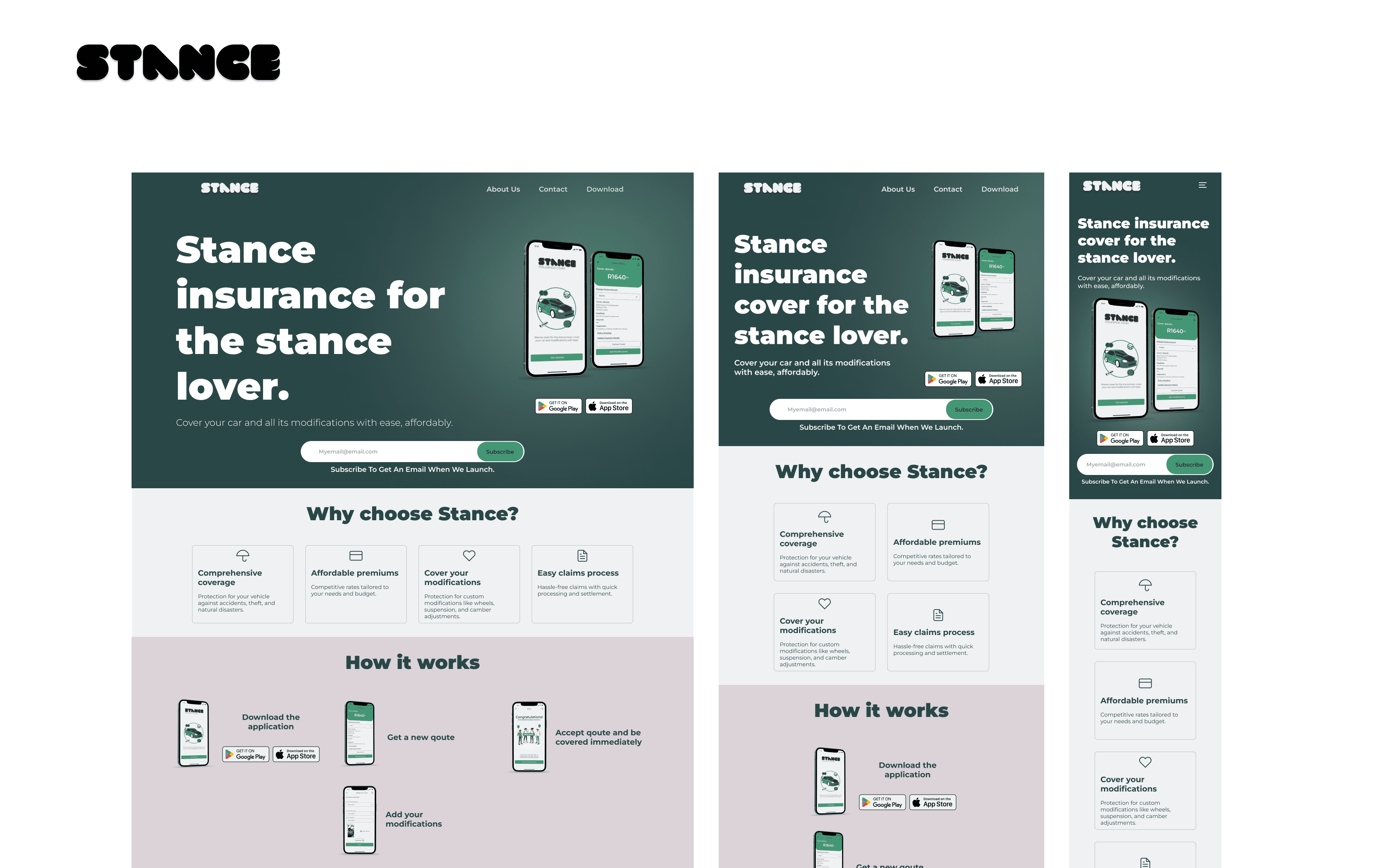
Stance Insurance is a South African digital insurance platform built for young drivers and car modification enthusiasts. It recognizes a group that most insurers ignore — people who genuinely love their cars and spend time (and money) making them unique.
The idea was simple: create an insurance experience that celebrates individuality instead of punishing it.

The Problem
The problem?
Young, modified-car owners are treated like a liability by most insurance companies.
If you’re under 30 and your car has been lowered, tuned, or wrapped — good luck finding fair coverage. Traditional insurers either reject these drivers or charge premiums that make no sense.
In research, one user told us:
“My insurance quote was higher than what I paid for my car. Just because I added coilovers.”
That stuck with me. It wasn’t just about insurance — it was about feeling unseen by an industry that should protect you.
Goal
To design an insurance experience that’s:
Transparent — users know exactly what’s covered
Empowering — celebrates modifications instead of punishing them
Fast & friendly — no jargon, no judgment
My Role
I worked as the UX Designer, responsible for:
User Research & insights synthesis
User Flows & Information Architecture
Wireframes & Prototypes
Usability Testing
UI Design System
I collaborated with one developer, a business analyst, and a marketing lead.
Together, we set out to redesign what “trust” feels like in digital insurance.
Design Process
1. Research
We interviewed young South African drivers between 18–30 who owned modified cars.
Key insights:
“I don’t trust insurance companies — they never explain the fine print.”
“I want to insure my mods. They’re part of my car’s identity.”
“Claims should be as simple as uploading photos.”
Pain points:
Complicated policy language
Unfair premiums
Slow, outdated claim processes
These insights grounded our design principles: clarity, speed, and celebration of individuality.
2. Personas
We developed personas to represent our core users:
Sipho (22) – first-time car owner, loves stance culture, wants flexible coverage.
Taryn (26) – freelance designer, owns a wrapped Mini Cooper, values transparency and control.
Jayden (29) – performance tuner, often rejected by insurers, needs modification coverage.
These personas helped us balance passion with practicality in the design.
3. Wireframing & Prototyping
We mapped the full journey: quote → coverage → claim.
Our first prototypes looked clean — but users still struggled with the insurance jargon.
So we rewrote everything:
“Comprehensive coverage” → “Everything’s covered — even your mods.”
“Third-party liability” → “Covers you if someone else’s car gets damaged.”
This copy change alone boosted comprehension and user trust.
We also added:
A “Mod Upload” feature (photo-based input during signup).

Quick-quote flow — 3 screens max.

Simple progress tracker during claims.

4. Usability Testing
We tested three rounds with 10 users each.
Every round shaped the next iteration.
Key results:
40% faster quote completion time
2× increase in successful claim submissions
Users described the design as “chilled but professional.”
That phrase became our UX tone anchor.
5. Visual Design
Car culture is bold, tactile, and fast — so the UI had to match.
We used:
Dark, matte palettes (black, dark green, carbon gray)
Light Green inspired by performance brake calipers
Rounded typography for readability
Minimal chrome to keep focus on content
Result: a confident interface that felt like part of the community — not a corporate outsider.

Key Features
✅ Mod-Friendly Coverage — insure custom parts & modifications
✅ Instant Quotes — no phone calls, just tap and go
✅ Simple Claims — upload, submit, done
✅ Full Mobile Access — manage policies anywhere
Reflection
This project reminded me that designing for niche communities means designing with empathy, not assumptions.
We didn’t just design an insurance app — we designed trust for a culture that had none.
And that, to me, is what UX is really about.